

Many businesses in search of a refresh or just starting out are looking for a professional website that will draw customers in and reflect the personality of their brand. In thinking about design, the ultimate focus is on layout, functionality, and the overall look and feel. The colors, graphics, and typography are all thoroughly planned and discussed. However, the menu item often pushed to the back burner in the mind of the business is photography. The initial thought process may be to place what is already available to save time and money. But will this achieve the best results? Quality website photos matter more than most people think when it comes to successful design.
A brand value mismatch.
The saying “You can’t judge a book by its cover” should hold true for many areas in life. Unfortunately, when it comes to brands and design it does not really apply. The reality is, brand value and how they are demonstrated through design matters to clients. If a business wants to convey trust and professionalism to its potential clientele, using low-quality cell phone pictures will not get that point across and possibly turn away revenue. A customer looking for quality work will feel the discord with photos that do not demonstrate quality themselves.
The making or breaking of a website design.
Whether a company is updating its website or creating a new one, photos can make or break the design. A new, beautifully designed website will feel just short with photos that do not reflect its updated look and will appear pieced together. When users visit the site and see a message of “pieced together” work, they could begin to question the quality of the business and customer satisfaction as a result. No matter how much time is spent on a professional website design, the wrong photos can discredit the work put in and may leave the design feeling flat and disjointed.
What is website quality?
Now knowing the importance quality photography plays in website design, it’s time to explore the criteria for what is considered website quality photos.
Tell the story.
Question: What is the story behind the photo?
Photos are an extension of the story being told on a website. Without any content, the photo should be able to communicate that story without difficulty. If the content and photo are not telling the same narrative, the user can feel perplexed but may not know why. Choosing photos that complement the story is imperative to a seamless message for the customer.
Good lighting.
Question: Can you clearly see the subject intended?
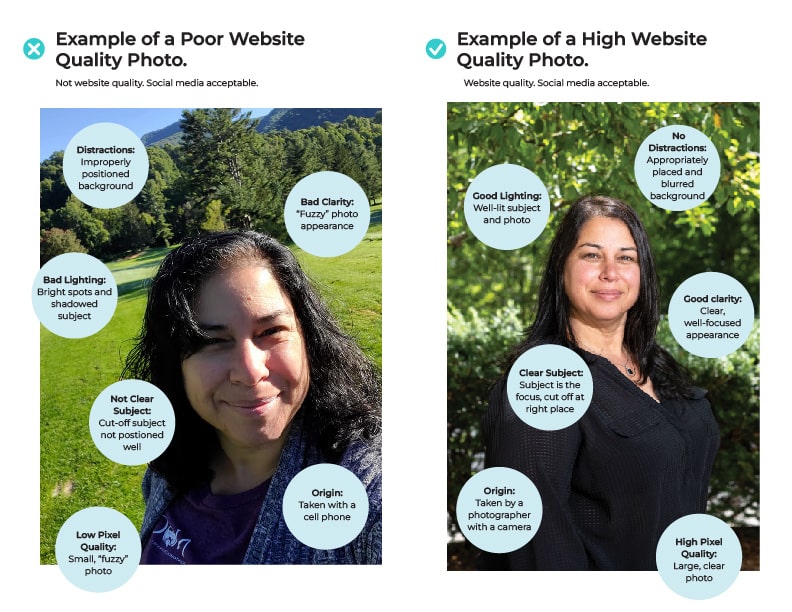
Good lighting can make a world of difference in photography. Dark or overly bright photos will cause the viewer to either find themselves searching for the subject or avoiding it altogether. A dimly lit subject can be just as distracting as a bright spot in the background pulling the client’s eyes away from the intended focus. A well-lit subject will speak to the audience.
Free of distractions.
Question: Can you identify the subject?
Nothing is more confusing or frustrating than not being able to figure out where to focus one’s attention. Too much background noise can cause the photo to appear busy and may not give a clear message of the content it’s meant to represent. Along with the confusion, the unpolished look may again show an apathetic portrayal of the company’s appearance. Keep the background clutter minimal with as few objects as possible that would take away from the subject’s spotlight.
Place of origin.
Question: Who took the photo? What was used to take the photo?
Although cell phone cameras have been making progress in leaps and bounds recently, many of them cannot replicate the quality of a professional camera. In addition to having the proper tools, the average person typically lacks the knowledge to take a website-quality photo even with a digital camera in tow. For best results, hiring a local professional photographer gives a business not only quality photos but also consistency in appearance and branding. Remember, quality and consistency convey trust to customers.
Pixel quality.
Question: How clear does the photo look? What size is it?
When it comes to photos, size does matter. Images are measured in pixels, tiny squares that make up an image. The more pixels per inch (PPI), the better, as photos need to be scaled to fit various spaces on a website. Low PPI resolution photos will look blurry when resized, compromising visibility and quality. As a general rule, 1920 x 1080 pixels is the minimum size for website photos as that is the standard desktop measurement and can be scaled down as necessary without losing excellence.
Good clarity.
Question: Is the intended subject clear?
While a good artistically taken photo can have a blurry background, the photo’s subject should not be blurred. A blurry subject shows poor quality and unprofessional camera work, leaving a bitter taste in the eye of the user. Make sure the subject is exactly that- a clear, main part of the photo.
Here is an example of what makes and does not make a website-quality photo.
What about stock?
The next thought would logically be to apply stock photography as it checks off all the boxes previously described. Sure, using some stock intermittently in a site can work well if proper guidance is followed. While stock photography can be a go-to for those lacking quality photos and budget for a professional photographer, there are a few things to consider when it comes to using stock photos.
Brand Consistency
Make sure that the chosen stock images have similar lighting, color, and styling. Adhering to these characteristics will ensure that the site looks cohesive and part of the brand aesthetic. A helpful tool is to use the “find similar” search bar found on most stock sites. This tool allows you to search the series or photographer, increasing the chances of consistency.
Genuine Feeling
When choosing stock photos, browse for photos that have a more genuine feel. People smiling directly at the camera have a fake vibe and will be off-putting to clients who are searching for transparency. In the same thought, overly edited photos with vignettes or shadowy borders will also contribute to the fake feeling. Avoid those as much as possible. Select stock that has people looking at each other or a task with a clear and professional appearance.
Storytelling
Though stock photography can assist in brand storytelling on a website, it will not always be a perfect fit in every place. Any content that speaks directly about the brand should not be paired with stock. For instance, a company that needs to place team or project photos should use its own photography in those areas. In this case, a professional photographer can be hired for these select sections if the budget cannot include an entire website of new photos.
Should all candid shots be thrown out?
Given the bar that is now set for website quality photos, are all those candid, on-the-job, low-quality shots ready for the trashcan? Not necessarily. While they have no place on the professional website, there is a perfect spot for them: social media. Clients scroll through social media looking for those genuine, down-to-earth shots of office birthday celebrations, having fun on the job, etc. for the humanity of the brand. Save all those photo moments for social media posts to connect with the target audience.
Conclusion
Photography plays a vital role in the user experience of a website. Following the guidance of good lighting, photo size, storytelling, and the proper use of media tools, a new or rebranding company can have a consistent visual appearance within its website. Are you looking to update or get started on your business’s online presence through custom website design? Digital Buzz Media does not just build websites, we match brands with their digital voice through bespoke website design, branded graphics, and more.
Check out our website design principles and portfolio: